Every contact center leader I meet can recite their problems from memory: the queue is long, the team is stretched, customers are impatient. What's harder to see from inside is whether those problems come from effort or from design, because the fixes are completely different. You can't staff your way out of a design problem.
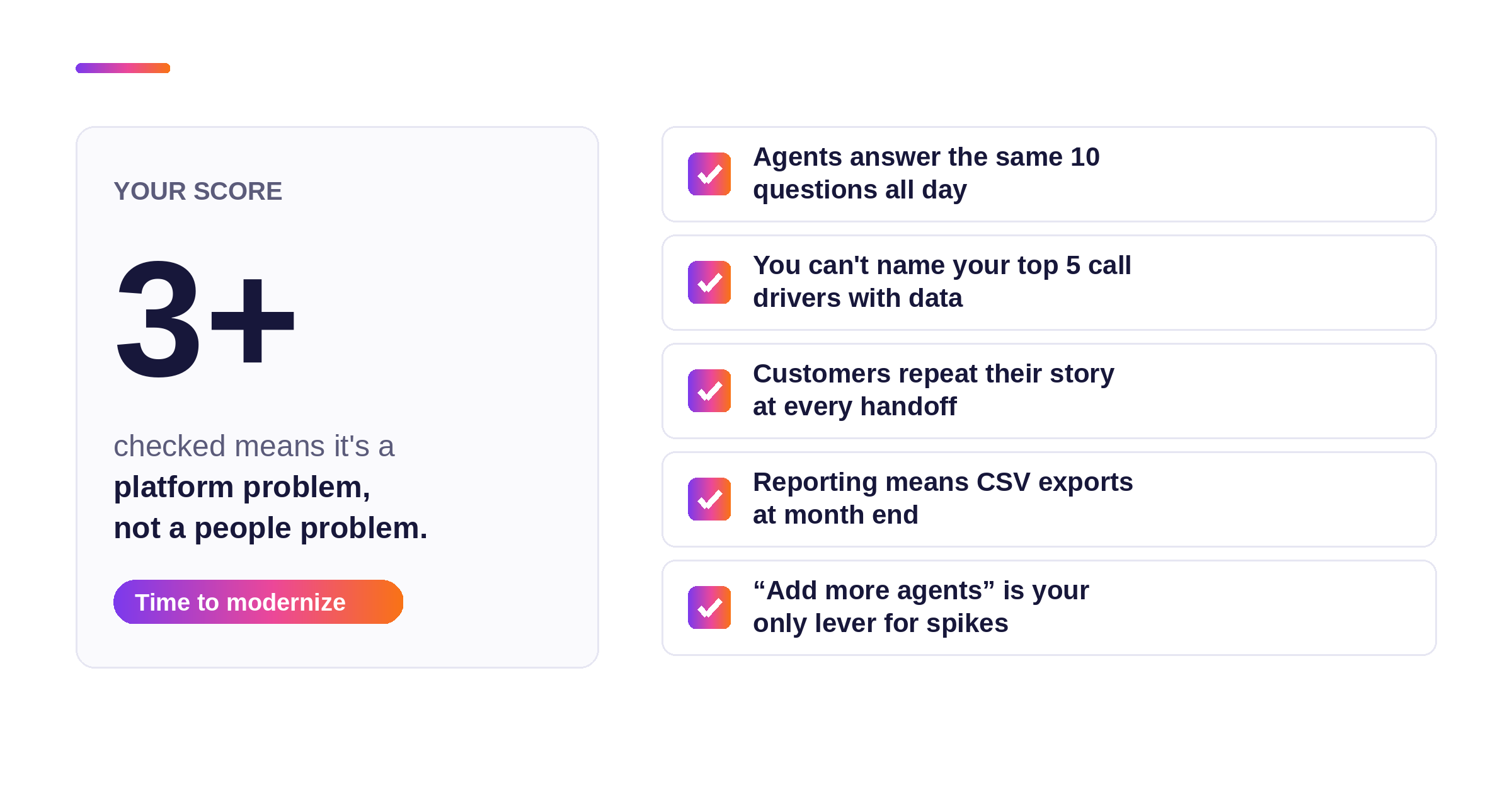
After enough operations, the design problems announce themselves through the same five signs. Count how many describe your operation honestly.
Sign 1: Agents answer the same ten questions all day
Where's my order. How do I reset this. What are your hours. If your team resolves these one at a time, hundreds of times a week, you're paying skilled humans to be a slow FAQ. This is the clearest signal that automation belongs in front of your queue. Modern AI handles the repetitive 25–40% of volume instantly, and your agents get the conversations that need them. We wrote a full breakdown of that division of labor here.
Sign 2: You can't name your top five call drivers with data
Not a guess, a number. If nobody can say what actually drives your volume and what each contact type costs, then every staffing, automation, and training decision is running on folklore. Call analytics is usually the first thing worth fixing, because the data pays for every decision that follows.
Sign 3: Customers repeat their story at every handoff
Phone doesn't know what chat said; the escalation doesn't know what the first agent tried. Each repeat adds handle time, drains customer patience, and tells you the channels are bolted together rather than integrated. A modern platform carries context with the conversation, across channels and across handoffs.
Sign 4: Reporting means CSV exports at month end
If understanding last month requires a spreadsheet ritual, your operation runs on a 30-day delay. Volume spikes, emerging product issues, and failing flows all surface weeks after they start costing you. Modern contact centers surface this in real time, which changes reporting from archaeology into steering.
Sign 5: “Add more agents” is your only lever
When volume spikes, healthy operations have several responses: automation absorbs more, self-service deflects more, routing tightens, and yes, sometimes staffing flexes. If hiring is the only lever on your panel, your costs scale linearly with volume forever. That's the treadmill modernization exists to break.
Scoring yourself
Zero or one sign: your platform is broadly serving you. Tune, don't replace. Two: start planning; these compound. Three or more: it's a platform problem, not a people problem, and the math usually favors acting now. A team handling 3,000 contacts a month with a third of them repetitive is typically spending $70,000–90,000+ a year answering questions that already live in its FAQ.
What to do about it this quarter
Not a big-bang replatform. The path we run with clients fits in about 30 days: pull 90 days of contact history and rank your drivers, pick two or three repetitive low-risk ones, automate just those with clean human handoffs, and measure containment and CSAT before choosing the next three. Small, measurable, reversible.
Counted three or more signs? Our free 30-day AI assessment maps your contact drivers, costs, and automation candidates against your own call data. The findings are yours either way. Get in touch.