Walk into almost any small or mid-sized company's contact center and you'll find the same scene: talented, well-trained people spending half their day answering the same ten questions. Where's my order. How do I reset my password. Can you update my address. What are your hours.
Ask the agents and they'll tell you exactly which questions those are. Ask the leaders and they'll tell you the team is stretched thin and the queue keeps growing. Both are right, and hiring more people won't fix it.
That's because repetitive volume isn't a staffing problem. It's a design problem.
The real division of labor
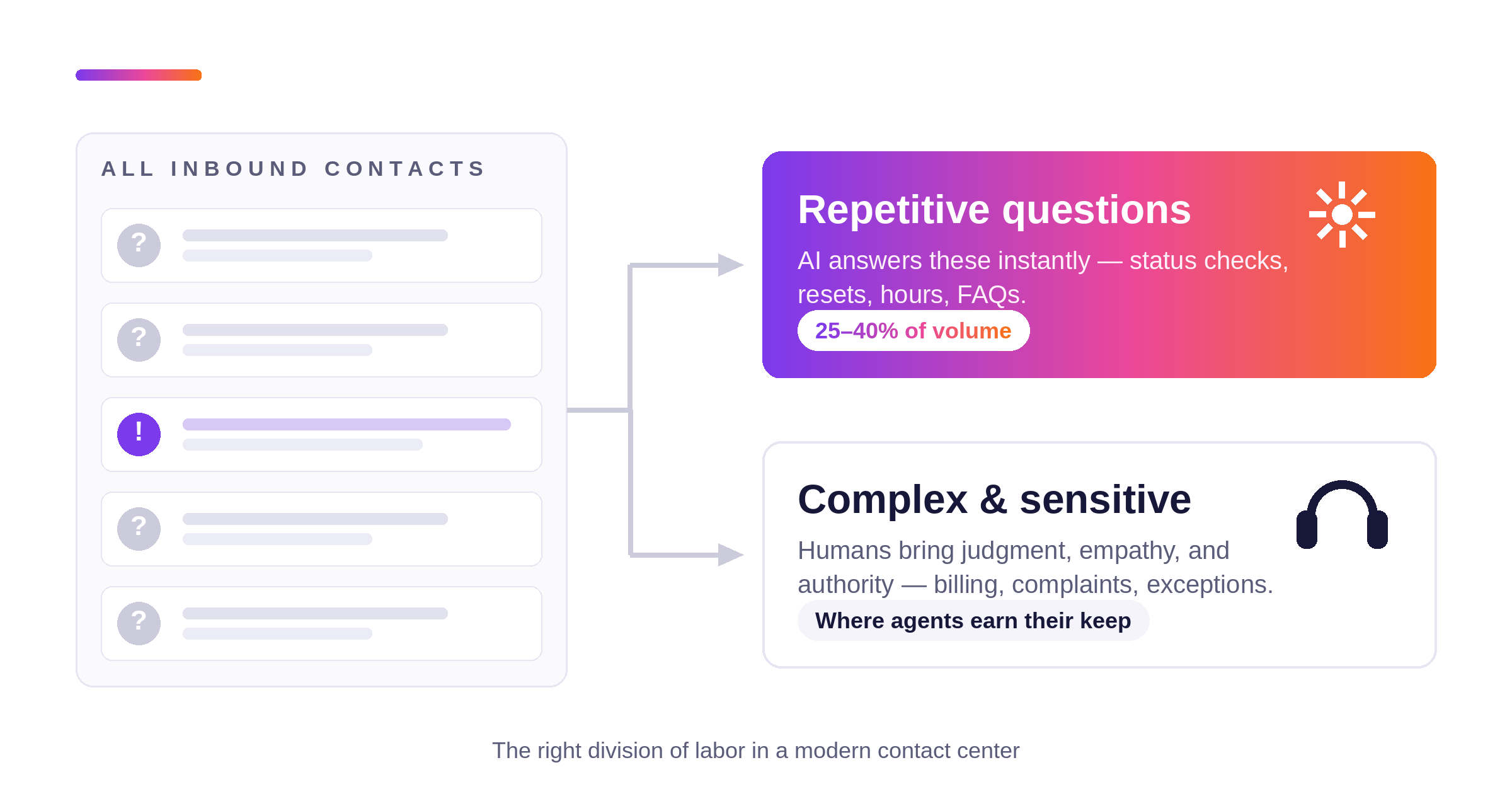
The fear version of AI in customer service, "the bots are replacing the humans," gets the story backwards. The teams getting genuine results in 2026 aren't swapping agents for AI. They're doing something more surgical: putting automation in front of the repeatable work, and reserving people for the conversations that actually need judgment, empathy, and authority.
A useful rule of thumb: in most SMB service operations, somewhere between a quarter and 40% of total contact volume is repetitive and low-risk. Order status. Store hours and locations. Password and account resets. Address changes. Appointment confirmations. These are interactions where the customer doesn't want a relationship. They want an answer in under a minute.
That's the "right 20%" (often more) to automate first. Not billing disputes. Not complaints. Not cancellations or anything emotionally loaded. Those are precisely where a human agent earns their keep, and where a badly deployed bot does real brand damage.
What changes when you get this right
- Queues shrink. The repetitive contacts never reach a human, so wait times fall for everyone else.
- Agents calm down. The soul-crushing repetition disappears, and with it a major driver of burnout and turnover.
- CSAT usually rises. Customers with simple questions get instant answers; customers with hard problems get a human who isn't rushing to clear a queue.
- Leaders finally see the data. A modern setup tells you exactly what drives your volume and what each contact type costs.
And the math is bigger than most leaders expect. A team handling 3,000 contacts a month, with a third of them repetitive, at a typical $6–8 cost per contact, is spending roughly $72,000–96,000 a year answering questions that already live in its FAQ. Automating even half of that pays for a modernization program on its own, before counting faster handle times or lower turnover.
How an SMB starts without betting the business
You don't need an enterprise budget or a big-bang replatform. The safe path fits in about 30 days:
- Week 1: get the data. Pull 90 days of contact history and rank your drivers by volume. (If your current system can't tell you this, that's finding #1.)
- Week 2: pick two or three drivers. Repetitive, low-risk, high-volume. Leave the sensitive categories alone.
- Week 3: automate just those, with a clean handoff to humans and obvious escape hatches at every step.
- Week 4: measure. Containment rate, CSAT on automated contacts, and agent hours freed. Then choose the next three drivers from evidence, not opinion.
Small, measurable, reversible. That's how modernization should feel.
Where to start this week
If you lead customer service, operations, or IT and any of this sounds familiar, start with visibility: can you name your top five contact drivers and what each costs you per month? If not, that's the first fix. The data ends up paying for everything that follows.
Want to know what the right 20% looks like in your operation? We run a free 30-day AI assessment that maps your contact drivers, costs, and automation candidates against your own call data, and the findings are yours either way. Get in touch.